

Nerve entrapments, medically known as entrapment neuropathies, are conditions that occur when peripheral nerves are compressed between muscles, ligaments, tendons or bony structures.
Depending on the area the nerve supplies, pain, numbness, tingling, burning, electric-shock sensations and sometimes muscle weakness may occur. Symptoms may worsen particularly at night, during repetitive movements or in certain positions.
Repetitive movements, prolonged pressure, trauma, anatomical variations, diabetes and some metabolic diseases can play a role in the development of nerve entrapments.
Common Nerve Entrapments
Carpal Tunnel Syndrome: This results from compression of the median nerve at the wrist. It can cause numbness, tingling and pain that worsens at night, particularly in the thumb, index and middle fingers. In advanced cases, weakness may develop in the thumb muscles.
Cubital Tunnel Syndrome (Ulnar Nerve Entrapment): This is compression of the ulnar nerve at the elbow. It can cause numbness and tingling, particularly in the little and ring fingers, and weakness of the hand muscles.
Meralgia Paresthetica: This results from compression of the lateral femoral cutaneous nerve, which supplies sensation to the outer thigh, usually in the groin area. Burning, numbness and tenderness are felt on the outer part of the thigh. Muscle weakness is not expected.
Peroneal Nerve Entrapment: This usually occurs on the outer side of the knee, around the head of the fibula. It can cause numbness on the outer part of the lower leg and the top of the foot and, in advanced cases, weakness in lifting the foot (foot drop).
Tarsal Tunnel Syndrome: This is compression of the tibial nerve on the inner side of the ankle. It can cause burning, numbness, tingling and pain in the sole of the foot.
Morton’s Neuroma: This is usually associated with thickening of the tissue around the nerve between the third and fourth toes and irritation of the nerve. Burning, stabbing pain in the forefoot that worsens when walking may occur.
Less Common Nerve Entrapments
- Guyon’s canal syndrome (ulnar nerve entrapment at the wrist)
- Radial tunnel syndrome and posterior interosseous nerve entrapment
- Pronator teres syndrome
- Anterior interosseous nerve syndrome
- Suprascapular nerve entrapment
- Neurogenic thoracic outlet syndrome
- Deep gluteal syndrome (sciatic nerve entrapment)
- Saphenous nerve entrapment
- Sural nerve entrapment
- Baxter’s nerve entrapment (heel region)
- Deep peroneal nerve entrapment (anterior tarsal tunnel syndrome)
Diagnosis of Nerve Entrapments
The patient’s symptoms and a detailed neurological examination are important in diagnosis. The effects of the nerve on sensation and muscle strength are assessed.
Electromyography (EMG) and nerve conduction studies play an important role in identifying the site of the entrapment, assessing the degree of damage and distinguishing it from other nerve disorders that cause similar symptoms.
High-resolution ultrasonography allows direct visualisation of the nerve’s thickness and structure, its relationship with surrounding tissues and possible causes of compression. Cysts around the nerve, anatomical variations and structural changes in particular can be assessed with ultrasound.
MRI may also be needed in some patients.
Treatment of Nerve Entrapments
Treatment is planned according to the affected nerve, the degree of compression and whether there is nerve damage.
Non-surgical methods can be used for mild and moderate nerve entrapments. However, surgical evaluation may be necessary for patients with marked or progressive muscle weakness and advanced nerve damage.
1. Physical Therapy
The aim of physical therapy in nerve entrapments is to reduce the mechanical pressure on the nerve, control pain and preserve muscle function.
Depending on the patient’s condition, nerve gliding exercises, stretching and strengthening, manual therapy and various physical modalities may be used.
Wrist splints in carpal tunnel syndrome, measures to prevent prolonged elbow flexion in cubital tunnel syndrome, and suitable orthoses in other entrapment neuropathies can be used.
Reducing repetitive movements, adjusting working conditions and avoiding positions that put pressure on the nerve are also important parts of treatment.
2. Interventional Physiatry
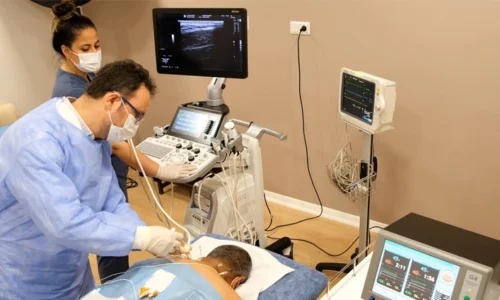
Ultrasound-guided targeted injections are interventional methods that can be considered in suitable patients for the treatment of nerve entrapments.
In ultrasound-guided “Pinpoint” procedures, the entrapped nerve, the surrounding blood vessels and other anatomical structures are visualised directly so that the needle can be guided to the target area.
With this method, medication can be delivered around the nerve, or special interventional techniques such as hydrodissection can be used.
Ultrasound-Guided Perineural Injections
Ultrasound-guided injections around the nerve can be performed particularly in carpal tunnel syndrome, meralgia paresthetica and some other entrapment neuropathies.
Depending on the characteristics of the condition, local anaesthetic, corticosteroid or other suitable injectates may be used.
The aim is to reduce the inflammatory reaction and pain around the nerve. Corticosteroid injections in particular can provide short-term relief in some nerve entrapments.
Nerve Hydrodissection
Hydrodissection is an interventional method in which fluid is injected around the entrapped nerve under ultrasound guidance with the aim of mechanically separating the nerve from the surrounding tissues.
Saline, dextrose-containing solutions or other suitable fluids can be used in this procedure.
Thanks to ultrasonography, the spread of the fluid injected around the nerve can be monitored in real time.
Hydrodissection is a treatment method being studied particularly in carpal tunnel syndrome and some other entrapment neuropathies. Although it can relieve symptoms in suitable patients, scientific evidence on its long-term effectiveness is still limited.
Pulsed Radiofrequency (PRF) Treatment
In some chronic nerve entrapments that do not respond to other treatments, pulsed radiofrequency (PRF) treatment of the affected nerve may be considered.
In this method, a controlled electrical field is applied through a special needle placed near the nerve with the aim of modulating pain transmission.
Unlike conventional radiofrequency, it is intended to be applied without causing significant heat damage.
Although it can be used in some painful entrapment neuropathies such as meralgia paresthetica, it is not a standard treatment for all nerve entrapments.
3. Surgical Treatment
Surgery may be necessary for advanced nerve entrapment, marked or progressive muscle weakness, muscle wasting, or symptoms that persist despite appropriate non-surgical treatment.
The main aim of surgery is to remove the mechanical pressure on the nerve.
Depending on the type of condition, carpal tunnel release, cubital tunnel release, peroneal nerve decompression, tarsal tunnel release and other peripheral nerve release operations may be performed.
The choice of treatment should be made by evaluating the patient’s symptoms, neurological examination, EMG and ultrasonography findings together.