

Elbow pain is one of the most common musculoskeletal problems and can affect daily life and arm movements. The most common causes include lateral epicondylitis (tennis elbow), medial epicondylitis (golfer’s elbow), tendon injuries, bursitis, osteoarthritis and nerve entrapments.
Lateral epicondylitis, one of the most frequent causes of elbow pain, is associated with overload and degenerative changes in the tendons where the muscles that lift the wrist and fingers attach to the outer side of the elbow.
Although it is called tennis elbow, it is not seen only in athletes. Computer use, working with hand tools and repetitive gripping and lifting movements can also worsen the symptoms. Typical findings are pain on the outer side of the elbow, difficulty gripping and tenderness that increases with wrist movements.
Diagnosis of Elbow Pain
Diagnosis begins with a physical examination. The location of the pain, muscle strength and elbow movements are assessed.
Musculoskeletal ultrasonography helps to assess tendon thickness, degenerative changes in its structure and partial tears, particularly in lateral epicondylitis. When necessary, MRI and EMG to investigate nerve entrapments may be used.
Treatment of Elbow Pain
Treatment is planned according to the source of the pain and how long the condition has lasted. The main options are activity modification, appropriate medication, physical therapy and interventional procedures.
1. Physical Therapy
The aim of physical therapy in elbow pain is to reduce pain, increase the load-bearing capacity of the tendons and improve arm function.
In particular, stretching and progressive strengthening exercises, manual therapy and appropriate physical modalities may be used. In lateral epicondylitis, ESWT (shock wave therapy) and laser therapy may also be considered in some patients.
Modifying repetitive strenuous movements and using an elbow strap when necessary can support treatment.
2. Interventional Physiatry
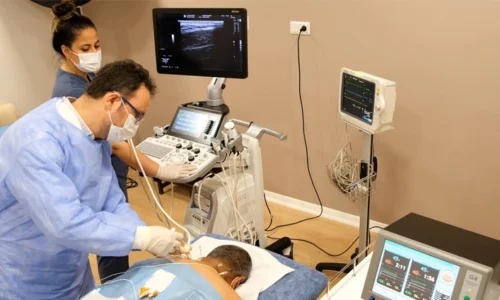
Ultrasound-guided targeted interventional procedures may be considered, especially for patients with long-standing lateral epicondylitis who have not benefited enough from other treatments.
In ultrasound-guided “Pinpoint” procedures, the damaged tendon and the surrounding tissues are visualised directly so that the needle can be guided to the target anatomical area.
Corticosteroid Injections
In some patients with severe pain, corticosteroid injections may be given for short-term pain control.
However, careful patient selection is required in lateral epicondylitis because long-term results are limited and the pain may recur. Injecting corticosteroid directly into the tendon and repeated injections should be avoided.
Radiofrequency and Cryoablation
For chronic elbow pain that does not respond to other treatments, radiofrequency or cryoablation targeting the nerve structures involved in pain transmission may be considered in suitable patients.
Radiofrequency treatment uses controlled electrical energy, while cryoablation uses cooling technology; both aim to reduce pain transmission.
Dry Needling and Tendon Fenestration
In chronic lateral epicondylitis, special needling techniques can be applied under ultrasound guidance to the damaged part of the tendon.
Tendon fenestration is a method in which multiple controlled needle passes are made into the damaged tendon area to stimulate the tissue’s natural healing response.
Dry needling can be applied to painful tissues around the muscles and tendons. In suitable patients, these methods may be considered together with other rehabilitation measures.
Regenerative Treatments
In lateral epicondylitis and some chronic tendon disorders, PRP (platelet-rich plasma) and similar autologous cell-based treatments may be considered to support the tissues’ natural healing processes.
PRP is plasma rich in growth factors, prepared from the patient’s own blood and applied to the damaged tendon area. Autologous cell-based treatments aim to make use of cellular components obtained from the patient’s own tissues.
Ultrasound guidance helps identify areas of degeneration and partial tears within the tendon and allows the treatment to be delivered precisely to the target.
Scientific research on the clinical effectiveness and long-term results of these methods is ongoing.
3. Surgical Treatment
Most patients with lateral epicondylitis do not need surgery.
However, surgical treatment may be considered in some patients who have long-standing, significant pain and loss of function despite appropriate non-surgical treatment.
Surgery may involve methods such as open or arthroscopic debridement of the damaged tendon tissue and tendon repair.
The choice of treatment is determined according to the patient’s symptoms, examination findings and imaging results.